1.4.4 Policy making addressing poverty
UN SDSN SUSTAINABLE DEVELOPMENT SOLUTIONS NETWORK – BOĞAZİÇİ UNIVERSITY
SDSN Turkey, founded in 2014 and hosted by Boğaziçi University, helps to realise the Sustainable Development Goals (SDGs) by mobilising its members in Turkey. In this context, it endeavours to develop anti-poverty policies and formulate policies in cooperation with local, regional, national and global authorities.
Founded in 2012 by former UN Secretary-General Ban Ki-moon and world-renowned economist and Professor Jeffrey Sachs, the SDSN supports integrated approaches to implementing the Sustainable Development Goals and the Paris Agreement on climate change through education, research, policy development and global collaboration.
The UN Sustainable Development Solutions Network (SDSN) works under the auspices of the UN Secretary-General to mobilise universities, think tanks, national organisations and businesses around the world to take action on the Sustainable Development Goals (SDGs) and the Paris Agreement on Climate Change.
The main objective of this network is to mobilise stakeholders to jointly develop solutions for sustainable development.
15 countries, 10 regions, +500 members United Nations Sustainable Development Goals
Sustainable Development Goals
Climate Change
Financing for Sustainable Development
National / Regional Networks
SDG Academy
Thematic Networks
Solutions Initiatives
ORGANISATION
SDSN Turkey was established in 2014 under the auspices of Boğaziçi University. The main objective of the network is to bring together universities, the business community and the public sector to create solutions for sustainable development in Turkey and the achievement of the Sustainable Development Goals. In September 2015, 17 sustainable development goals were decided at the United Nations General Assembly with the acceptance of all member states, and it was decided to achieve these goals by 2030.
LEADERSHIP COUNCIL











SOCIAL POLICY FORUM
About Us
The Social Policy Forum is a Boğaziçi University research center founded in 2004 to support scientific research and the training of researchers in areas pertaining to social policies and social inequalities and to contribute to the social policymaking process through empirical research.
The Forum takes a rights-based approach to social policy approach and investigates social policies in their historical, economic, political and social contexts. It encourages comparative research, particularly in studies where social policy developments in Turkey are examined in the broader context of European or global trends.
The Forum’s research agenda encompasses the following themes:
- Social inequality, poverty and social exclusion.
- Developments in social services: health and health care, education, social care.
- Developments in the realm of labor, including employment relations and the role of labor organizations and movements.
- Pension systems, income support programs, and social assistance mechanisms.
- Policies on housing and public transport.
- Interactions between social actors and political processes in social policymaking.
- The impact of a wide range of international and national organizations (non-governmental organizations and humanitarian and philanthropic organizations) on social policies and their role in social policymaking.
- The study of social policies from the perspective of human rights frameworks, including but not limited to gender equality, disability rights and children's rights.
The Forum encourages young researchers to engage in the global research agenda and global and domestic debates on social policies and social inequalities. It fosters close collaboration between experienced researchers and doctoral and master’s students in a wide range of social science disciplines. To facilitate achieving these aims, the Social Policy Forum and the United Kingdom’s Social Policy Association agreed to a formal International Affiliation in 2018. The Forum also signed a three-year international partnership with the Raoul Wallenberg Institute of Human Rights in 2018.
The Social Policy Forum provides information to raise awareness among the general public, academia and the intellectual community, the media, policymakers, and practitioners about recent global developments and debates on social policies and social inequalities. It organizes seminars, workshops and roundtables that engage students, academics, policymakers and NGO representatives to discuss topical social policy developments and social inequalities and to share its research findings.
Projects
Ongoing Projects
Development of Researcher Manpower in Social Sciences (Supported by the Ministry of Development of the Republic of Turkey)
Team: Ünal Zenginobuz (executive), Ayşe Buğra (former executive) Period: 2010-...
Completed Projects
Cooperation between Raoul Wallenberg Institute and Boğaziçi University Social Policy Forum on Disability Studies
Team: Volkan Yılmaz (coordinator), Anıl Gencelli (research assistant), Nazlı Avşaroğlu (research assistant) and Begüm Özcan (administrative coordinator) Period: 2017-2020
Regulatory Problems and Solutions in Mixed Health Systems (British Academy)
Team: Volkan Yılmaz (principal investigator), Susan F. Murray (co-investigator, King's College London), Benjamin Hunter (co-investigator, King's College London) and Püren Aktaş (research assistant)Period: 2018-2020
ETHOS:Horizon 2020 Reversing Inequalities and Promoting Fairness
Team: Prof. Dr. Ayşe Buğra, Başak Ekim Akkan Period: 2017-2020
Perception of Social Dialogue in Turkey: Perspectives of the Public, Workers and Related Actors (with ILO Support)
Team: Fikret Adaman, Ayşe Buğra, Volkan Yılmaz, Aziz Çelik, Alpkan Birelma, Begüm Özcan, İrem İnalPeriod: 2017-2018
The Impact of Civil Society Organisations Working in the Field of Disability Rights on Public Policies (Supported by Sabancı Foundation)
Team: Volkan Yılmaz (principal investigator) and Anıl Gencelli (research assistant) Period: 2017-2018
Team: Volkan Yılmaz (principal investigator), Ayşe Meryem Akbulut Gürpınar (research assistant) and Talita Çetinoğlu (visiting researcher, University of Manchester)Period: 2017
Different Views of Rural Poverty in Contemporary Turkey
Team: Dr Özgür Burçak Gürsoy , Berra Zeynep Dodurka Period: 2016
Being a Woman in the Eastern Black Sea Region
Team: Dr İpek Göçmen , Selen Lermioğlu Yılmaz Period: 2013
The Problem of Coverage in Social Protection Programmes: A Study on the Determinants of Green Card Ownership and Non-utilisation
Team: Prof. Dr. Fikret Adaman, Assist. Prof. Dr. Burçay Erus, Dr. Burcu Yakut-Çakar, Prof. Dr. Şanda Çalı Period: 2010-2011
Team: Assist. Assoc. Prof. Dr. Ayşen Candaş, Başak Ekim Akkan, Mehmet Baki Deniz, Sevda Uğur Günseli Period: 2010-2011
Development of Integrated Social Policies for Roma Communities
Team: Başak Ekim Akkan, Başak Erel, Figen Kelemer, Goncagül Gümüş, Özlem Anadol, Mehmet Baki Deniz, Mehmet Ertan Period: 2010-2011
Team: Prof. Şemsa Özar, Dr Burcu Yakut Çakar, Volkan Yılmaz, Aslı Orhon, Pınar GümüşPeriod: 2009-2011
Inequalities in Turkey: In Search of an Integrated Conceptual Framework
Team: Assist. Assoc. Prof. Dr. Ayşen Candaş, Volkan Yılmaz, Sevda Uğur Günseli, Dr Burcu Yakut Çakar Period: 2009-2010
Gender, Labour Markets and Welfare Regimes: Women's Employment in Turkey
Team: Prof. Dr. Ayşe Buğra, Fırat Kurt, Hatice Pınar Şenoğuz, Yalçın Özkan, Dr Burcu Yakut-Çakar Period: 2009-2010
A Proposal for the Dissemination of Child Care Services in Turkey: Neighbourhood Nurseries
Team: Assist. Assoc. Prof. Dr. Berna Yazıcı, Çağrı Yoltar, Azer Kılıç Period: 2008-2009
Employment Structure and Subsistence Methods of the Poorest Segment of the Urban Population
Team: Prof. Dr. Ayşe Buğra, Prof. Dr. Çağlar Keyder, Burcu Yakut-Çakar, Çağrı Yoltar, Fırat Kurt Period: 2007-2008
Social Assistance Through a Contribution to Public Welfare
Team: Prof. Dr. Ayşe Buğra, Prof. Dr. Çağlar KeyderPeriod: 2007
Social Policy in the Development of Eastern and Southeastern Anatolia
Team: Prof. Dr. Çağlar Keyder, Assist. Assoc. Prof. Dr. Nazan Üstündağ Period: 2006
Independent Group of Experts on Combating Poverty and Social Exclusion
Team: Prof. Dr. Ayşe Buğra, Burcu Yakut-Çakar Term: 2005-2006
Poverty and Social Exclusion in Metropolitan Suburbs in Turkey
Team: Fikret Adaman, Çağlar KeyderPeriod: 2005-2006
Team: Prof. Dr. Çağlar Keyder, Assist. Prof. Dr. Nazan Üstündağ, Tuba İnci Ağartan, Çağrı Yoltar Period: 2004-2006
A Study on the Cost of a Cash Poverty Assistance Policy in Turkey Based on Different Scenarios
Team: Prof. Dr. Ayşe Buğra, N. Tolga Sınmazdemir Period: 2004-2005
New Developments in Labour Life and the Changing Role of Trade Unions
Team: Prof. Dr. Ayşe Buğra, Prof. Dr. Fikret Adaman, Prof. Dr. Ahmet İnsel, Burcu Yakut-Çakar Term: 2004-2005
https://spf.bogazici.edu.tr/tr/projects
Boğaziçi University Human Development Research and Application Centre organised a webinar to discuss current research on refugees
On 5 March, Boğaziçi University Human Development Research and Application Centre organised a webinar titled "Rethinking Refugee Incorporation". The event, moderated by Prof. Dr. Mine Eder, Professor of Political Science and International Relations at Boğaziçi University, who is the director of the research centre, discussed the inclusion of refugees in society in the light of current research.
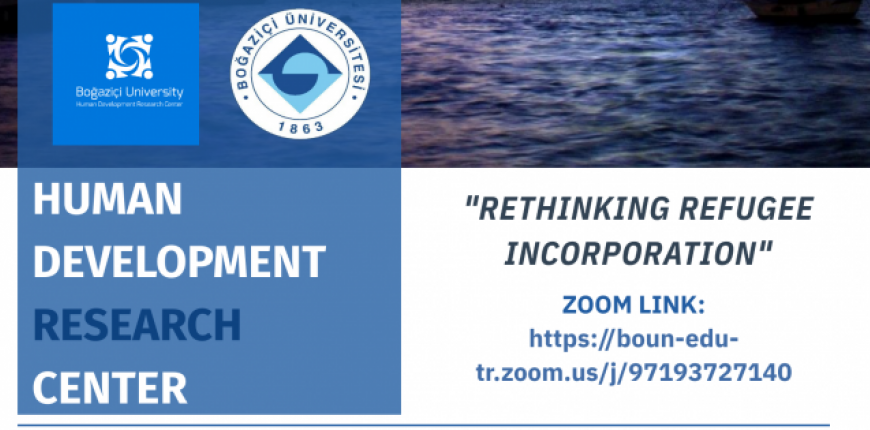
Three presentations were made in the webinar, where different topics ranging from legal recognition processes of refugees to access to health services were discussed: Derya Özkul from Oxford University Centre for Refugee Studies, "Recognizing Refugees: From UNHCR to state bureaucracies", Derya Özkul from Oxford University Refugee Research Centre talked about the process of recognition of refugees by states, which has been transforming in the world and in Turkey. In the light of her recent research, Derya Özkul stated that the factors determining the recognition of refugees vary with some institutional processes. Explaining that these processes, all of which are called RSD (Refugee Status Determination), are decided by various state authorities as well as UNHCR (United Nations High Commissioner for Refugees), Derya Özkul underlined that there are question marks about the transparency and fairness of refugee recognition processes. Özkul also added that with the establishment of UNHCR, the bureaucratic recognition of refugees has undergone a significant transformation.
In her presentation titled "Syrian refugees and transition to migrant health centres" , Nihal Kayalı, the second speaker of the event, emphasised that one of the most important indicators of the legal status of approximately 6 million registered Syrian migrants under temporary protection is access to health services. Stating that the main problem in Turkey in this regard is the language barrier of Syrian migrants and the changes in health services in recent years, Kayalı reminded that the SIHHAT project, launched in 2016 with the cooperation of the Ministry of Health and the EU, aims to support and improve primary and secondary health care services for Syrian migrants. Kayalı continued his words as follows: "Within the scope of the SIHHAT project, the number of Migrant Health Centres (GSM) established throughout the country is being increased. In these centres, primary health care services are provided to unregistered migrants and non-Syrian migrants. In my research project, I conducted in-depth interviews in Istanbul to understand how the transformation is experienced by Syrian migrants, especially when they are directed to Migrant Health Centres. There is a persistent tension among migrants about access to primary and secondary care. Migrants who want to access secondary services have to apply to private health clinics. We observe that those who previously had access to Family Health Centres are now directed to Migrant Health Centres, and in this sense we observe a segregation."
Giving the example of the Family Health Centre in Güngören, Nihal Kayalı added that this centre also has a migrant unit, but since it is not in a separate building, it is an example that should be considered in terms of integrating refugees into society.
In the last speech of the event, Sibel Karadağ, Deniz Sert and Didem Danış from Migration Research Association shared the findings of their research . In the speech titled"Afghans at the margins of precarity", the precarious living conditions of Afghan migrants living in Istanbul were discussed. The mechanisms of exploitation to which Afghans are exposed both along their migration routes and in their lives in Istanbul, their vulnerable, anxious and precarious lives caused by their lack of registration or documentation, and the working conditions that constitute heavy labour in the informal sector were emphasised. Sibel Karadağ continued her speech as follows: "There is international, legal and institutional precarity for Afghans. According to the findings of in-depth interviews, we realised that Uzbeks and Turkmens are the most privileged group in legal processes. The fact that they use Turkish is an important factor here. It is easier for them to find a job, work in restaurants or markets, and rent a house. This group, who have come to Turkey before and established an order, are called "muhaberat". These people create a communication network to harbour newcomers. Newly arrived Afghans who have no relatives stay in parks or mosques for a few days. The mukhabarat at certain points help the newcomers. They solve their problems themselves.
Afghans move very quickly from one place to another, from one job to another, they work without a private life and without rest. Afghans are in a different situation than other refugees because they are positioned at the very edge of precarity. Their physical and arduous labour, lack of international protection and legal insecurity condemn them to the hidden corners of Istanbul."
2024 Sustainability Report SDG-1 (Related Section)
Fighting Poverty: Policies and Activities
UN SDSN Sustainable Development Solutions Network - Boğaziçi University
In September 2015, 17 Sustainable Development Goals (SDGs) were set at the United Nations General Assembly with the acceptance of all member states and it was decided to achieve these goals by 2030. The United Nations Sustainable Development Solutions Network (SDSN) operates under the auspices of the UN Secretary-General to mobilise universities, think tanks, national organisations and the business world in line with the Sustainable Development Goals (SDGs) and the Paris Agreement on Climate Change.
The SDSN Turkey Network, established in 2014 and hosted by Boğaziçi University, aims to produce common solutions for the Sustainable Development Goals by promoting cooperation and coordination among its members in Turkey. In this framework, it leads the development of anti- poverty and sustainable development policies in cooperation with local, regional, national and global authorities.
Leadership Council:
Click here to go to SDSN Turkey web page:
https://unsdsn.bogazici.edu.tr/tr
Boğaziçi University Social Policy Forum
The Social Policy Forum is an application and research centre established in 2004 at Boğaziçi University to support scientific research on social policies and social inequalities and the training of researchers, as well as to contribute to social policy-making processes. Focusing on human rights, the Forum addresses social policy processes with their historical, economic, political and social dimensions. The Forum analyses social policy developments in Turkey from a comparative perspective in the context of European and global trends. The Forum aims to contribute to bringing the debates on social justice and social policies to the public opinion in Turkey, and to make sure that these debates attract the attention of academics and students as well as the intellectual community, the media, policy decision-makers and implementers.
The Forum's prioritised areas of work are as follows:
1. Social inequalities, poverty and social exclusion;
2. Developments in health, education, social care and other social services;
3. Developments and regulations in the world of work, unemployment, labour relations and the role of trade unions;
4. Pension systems, income support programmes and the functioning of social assistance mechanisms;
5. Housing and shelter policies, public transport policies;
6. Interaction between social actors and political processes in the field of social policy;
7. The impact of global and local political dynamics, international organisations, civil society organisations, humanitarian aid organisations and philanthropic organisations on social policy;
8. Analysing social policies in terms of human rights-based approaches such as gender equality, disability rights, children's rights.
The Forum aims to raise awareness in the field of social policy through seminars, workshops and scientific publications attended by academics, students, representatives of public institutions and civil society organisations. Research results are shared with international organisations such as the United Nations, politicians, bureaucrats, journalists and opinion leaders to contribute to policy processes. In addition, meetings and events are organised with the participation of scientists from Turkey and around the world to support the production of knowledge in the field of social policy at national and international level.
Past and Ongoing Projects:
- Development of Researcher Manpower in Social Sciences (Supported by the Ministry of Development of the Republic of Turkey)
- Cooperation between Raoul Wallenberg Institute and Boğaziçi University Social Policy Forum on Disability Studies
- Regulatory Problems and Solutions in Mixed Health Systems (British Academy)
- ETHOS:Horizon 2020 Reversing Inequalities and Promoting Fairness
- Perception of Social Dialogue in Turkey: Perspectives of the Public, Workers and Related Actors (with ILO Support)
- The Impact of Civil Society Organisations Working in the Field of Disability Rights on Public Policies (Supported by Sabancı Foundation)
- The Nature and Limits of the Welfare Mix Formed for Syrian Refugees from the Perspective of Humanitarian Aid Workers (Boğaziçi University Scientific Research Projects)
- Different Views of Rural Poverty in Contemporary Turkey Being a Woman in the Eastern Black Sea Region
- The Problem of Coverage in Social Protection Programmes: A Study on the Determinants of Green Card Ownership and Non-utilisation Food at School
- Development of Integrated Social Policies for Roma Communities Project
- Research Project for the Development of a Cash Social Assistance Programme for Divorced and Deceased Women
- Inequalities in Turkey: In Search of an Integrated Conceptual Framework
- Gender, Labour Markets and Welfare Regimes: Women's Employment in Turkey
- A Proposal for the Dissemination of Child Care Services in Turkey: Neighbourhood Nurseries
- Employment Structure and Subsistence Methods of the Poorest Segment of the Urban Population
- Social assistance through a contribution to public welfare Social Policy in the Development of Eastern and Southeastern Anatolia
- Independent Group of Experts on Combating Poverty and Social Exclusion
- Poverty and Social Exclusion in Metropolitan Suburbs in Turkey Problems, Preferences and Alternative Health Models of Health Services Users in Turkey from the Perspective of World Health Systems Transformation
- A Study on the Cost of a Cash Poverty Assistance Policy in Turkey Based on Different Scenarios
- New Developments in Labour Life and the Changing Role of Trade Unions
Click here to go to the Social Policy Forum web page:
- Different Views of Rural Poverty in Contemporary Turkey Being a Woman in the Eastern Black Sea Region
- The Problem of Coverage in Social Protection Programmes: A Study on the Determinants of Green Card Ownership and Non-utilisation Food at School
- Development of Integrated Social Policies for Roma Communities Project
- Research Project for the Development of a Cash Social Assistance Programme for Divorced and Deceased Women
- Inequalities in Turkey: In Search of an Integrated Conceptual Framework
- Gender, Labour Markets and Welfare Regimes: Women's Employment in Turkey
- A Proposal for the Dissemination of Child Care Services in Turkey: Neighbourhood Nurseries
- Employment Structure and Subsistence Methods of the Poorest Segment of the Urban Population
- Social assistance through a contribution to public welfare Social Policy in the Development of Eastern and Southeastern Anatolia
- Independent Group of Experts on Combating Poverty and Social Exclusion
- Poverty and Social Exclusion in Metropolitan Suburbs in Turkey Problems, Preferences and Alternative Health Models of Health Services Users in Turkey from the Perspective of World Health Systems Transformation
- A Study on the Cost of a Cash Poverty Assistance Policy in Turkey Based on Different Scenarios
- New Developments in Labour Life and the Changing Role of Trade Unions
Click here to go to the Social Policy Forum web page:
Rethinking Refugee Incorporation
Rethinking Refugee Incorporation
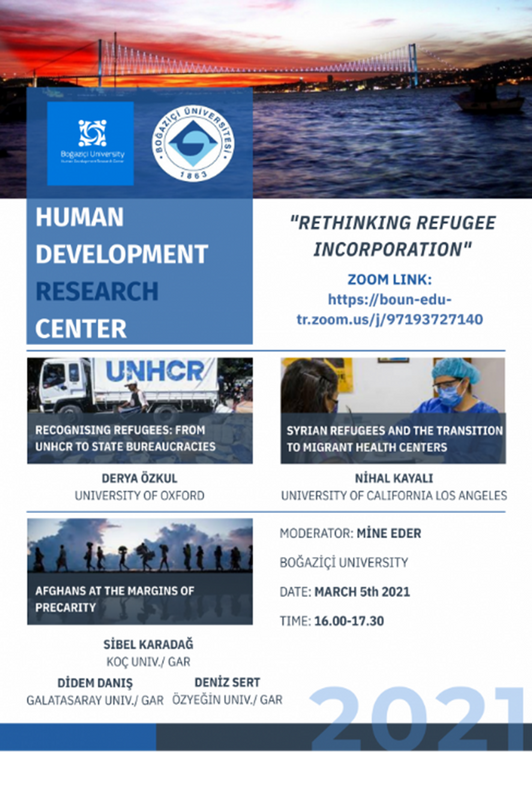
Boğaziçi University Human Development Research and Application Centre organised a webinar titled ‘Rethinking Refugee Incorporation’ on 5 March 2021. In the event, the inclusion processes of migrants were discussed in the light of current research.
Three presentations were made during the webinar:
Derya Özkul (Oxford University Centre for Refugee Studies)
- "Recognising Refugees: From UNHCR to state bureaucracies’, she explained the transformations in the recognition of refugees by states in Turkey and around the world.
Nihal Kayalı
- In her presentation ‘Syrian refugees and transition to migrant health centres’, she discussed the language barriers and system changes faced by approximately 6 million Syrian migrants in accessing health services. Mr Kayalı reminded the aim of the SIHHAT project to bring solutions to these problems.
Sibel Karadağ (Migration Research Association)
- In his presentation titled ‘Afghans at the margins of precarity’, he focused on the problems of Afghan migrants living in Istanbul, such as exploitation, undocumented and precarious working conditions.
The webinar provided a platform for a comprehensive discussion on the integration of migrants and the challenges they face.
Rethinking Refugee Incorporation
Click here to read the related news:
No poverty
End poverty in all of its forms everywhere.